
Contracting For The Unknown Using ADR


[Image: "Cap'n Archie" fortune telling machine, Archie McPhee store, Seattle, Washington, March 20, 2007, by Joe Mabel]


     Healthcare providers and insurers sign contracts every day that extend well beyond the horizon of the world in which they operate. The unknown dimensions of the future healthcare marketplace became even more uncertain with the recent passage of federal healthcare reform legislation. Many of the concepts contained in that law are subject to interpretation and political implementation, not to mention the possibility of repeal or modification by a future Congress.

     Healthcare lawyers routinely seek some protection from future uncertainty affecting their clients' contracts by drafting "out" clauses that spring into effect upon the happening of certain significant events. Among these are governmental findings of illegality or adverse tax effects, changes in the law and substantial failure of economic expectations. Typically, these contractual provisions (1) define the potential adverse event; (2) require that the parties attempt to negotiate a contractual amendment to resolve the problem; and (3) in the absence of agreement, permit either party to terminate on short notice. Robin Fisk recently discussed this topic in the context of provider - payor contracting in her Managed Care Contracting & Provider Payment blog. I think the concept has even wider application. Hospital-physician service contracts, joint venture agreements and institutional affiliations of all stripes can also expect to be affected by presently unknown legal and economic developments.

     Allowing either party to terminate a contract upon an adverse event is a simple and effective solution to the problem created by that event.  But it leaves the parties without a contract. Rarely is such an event so intractable that it could not have been dealt with had the parties known of it at the inception of the contract. Rather than terminating the contract, the parties can provide in advance for how they want its negative consequences to be resolved, and then employ an alternative dispute resolution process to reach a solution.

     The key elements of such a provision include (1) a clear definition of what constitutes the adverse event; (2) the principles that will guide how the adverse event is to be alleviated (e.g., "the parties agree to implement the minimum change required to eliminate illegality while preserving the structure and economic result of the relationship to the greatest extent possible"); and (3) a process to resolve any dispute in the implementation of this provision.

     With respect to process, a multi-step dispute resolution clause is particularly well suited to this situation. As recently defined by John DeGroote in his Settlement Perspectives blog

A multi-step dispute resolution clause is a contractual provision that requires the parties to an agreement to escalate a dispute through varying levels of management or other processes, such as mediation, using agreed-upon procedures before litigation or arbitration may proceed.

     Along with a multi-step resolution clause, parties seeking to address unknown, adverse events through ADR would do well to define their selection of an ADR neutral to suit the events in question. This requires more than the designation of a neutral to be provided by an ADR service (e.g. AAA, AHLA). It should also include a requirement of experience in representing parties with respect to the issues raised by the adverse event.

     Some unknown adverse events may so dramatically frustrate the parties' original expectations that it makes no sense to continue their contract. Most do not. Rather than abandon or renegotiate an entire contract, a multi-step ADR clause can often preserve the benefit of the original bargain for both parties.

Emotions In Mediation: Beware The Runaway Train

     Every dispute comes to mediation wrapped in emotion. Sometimes it relates to the wrong or harm arising from the conduct that triggered the dispute. Other times, it is simply the emotion surrounding months or years of being on one side of the dispute and believing the other side to be wrong. Or it can be both. Traditional mediation theory holds that it is vitally important for both sides to have the opportunity to express their emotions, and for the mediator to acknowledge them. This is thought to be beneficial because:

- It may be the first and only opportunity a party has to meaningfully "vent," without which that party can never put the dispute to rest.

- It enables each party to hear what the other really feels, without which a willingness to address those feelings in a settlement cannot be achieved.

- It educates the parties and their counsel on what the mediator is up against, thus guiding realistic negotiations.

     I have always accepted the wisdom of encouraging parties' expressions of emotion in mediation, and have permitted parties to "vent" with few limitations. ("Venting" by counsel is another matter, and generally not worthy of much leeway.)  I have found that parties appreciate the opportunity to express strong emotions, and that my acknowledgment of their feelings goes a long way towards building the credibility required to resolve the dispute later in the day.

     Recently, Dan Ariely, the author of the terrific book Predictably Irrational and the blog of the same name, wrote about "The Long Term Effects Of Short-Term Emotions." His research in the field of behavioral economics is fascinating, and can be related to the decision-making process of parties in the midst of dispute resolution. He has found that decisions made under the influence of short term emotions are often poorly made, by objective standards. Moreover, such decisions have a powerful, precedent setting effect on all later decisions. What does this mean for mediation?

1. Expressions of emotion can create an ideal environment for bad (i.e., irrational) decision-making. Letting parties "vent" may be valuable for the reasons noted above, but the mediator must recognize that it creates the potential for momentum that may be difficult to keep on the tracks.

2- A decision motivated by negative emotions that creates a dispute will tend to lead to subsequent decisions consistent with the first, long after the initial motivating emotions have subsided. People look for and value consistency in their actions. Revisiting the emotions associated with an early decision will help only if those emotions can be carefully separated from the objective consequences of adhering to that original position.


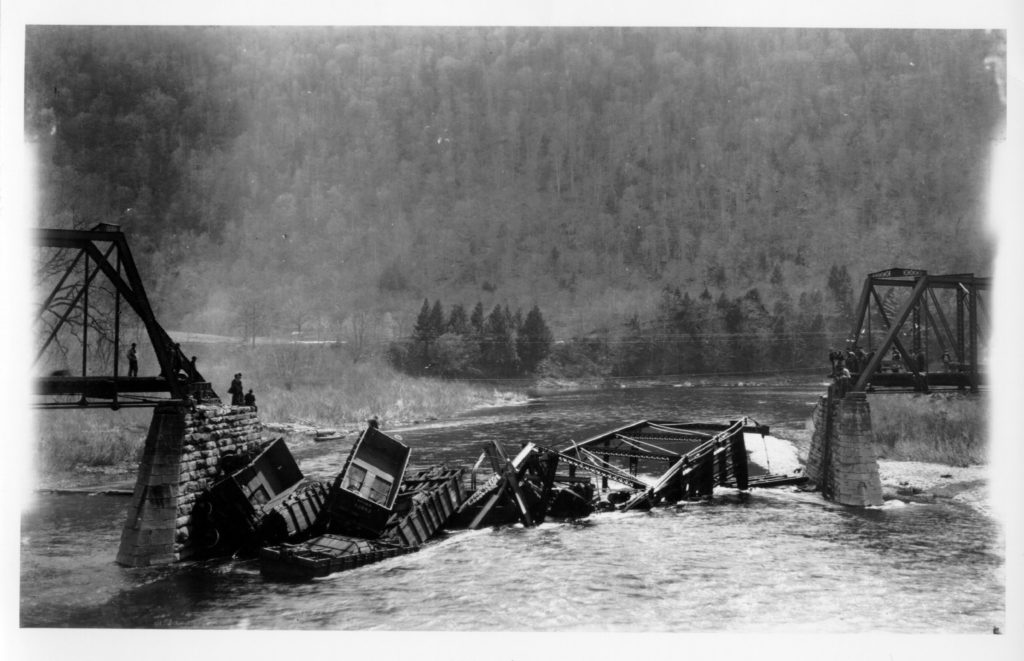
 [Runaway coal train at Fishs Eddy, New York, in the East Branch of the Delaware River, January 1, 1870, Cornell University Library]