
What's A Doctor Worth To A Hospital?

     In the ongoing symbiotic relationship between hospitals and members of their medical staffs, it is understood that the physicians generate hospital revenue by admitting their patients and ordering tests and procedures. But exactly how much is any doctor "worth" in this sense? Thanks to the HealthLaw Prof Blog, I saw that James A. White recently covered this issue in the Wall Street Journal Health Blog. Citing to a study of 114 U.S.hospitals by physician recruiters Merritt Hawkins, the WSJ produced a chart listing average hospital net inpatient and outpatient dollars derived from referrals, tests and procedures done in the hospital.

     The chart showed average hospital revenue ranging from a low of $696,888 (from nephrology) to a high of $2,815,650 (for neurosurgery). The average for internal medicine was $1,678,341. The article doesn't talk about the hospitals' costs to provide the services that resulted in the hospital revenue described. Although some costs are evenly distributed among all patients, some are not.

     Any hospital administrator will tell you that not many days go by without some physician on staff reminding the administrator of how much his or her presence is "worth" to the hospital. Unlike most other fields of endeavor, physicians by law cannot be paid by the hospital for what they are "worth" in business generation. But that doesn't mean physicians will not expect to be compensated for that value in some way. Nor does it mean that hospitals can afford to be oblivious to this calculation of value.

     Whether in negotiating employment compensation, the structure of a joint venture, or the terms of a services agreement, a hospital should know what the physician across the table is worth in hospital revenue. Although this is not the only value of the physician to be assessed, and the hospital cannot base its offer on the value of physician business generation, the potential loss or absence of that hospital business is certainly a major factor in calculating what mediators call the hospital's WATNA (worst alternative to a negotiated agreement).

     This analysis is complicated, and may yield unexpected results. But failing to do it is like ignoring the size of the pot on the table. You will end up paying too much, or folding on deals the hospital can't afford to lose. 

[Image: Hole cards in a game of Texas hold'em, by Thomas van de Weerd, September 2, 2006]

Medicaid Cuts Will Strain Hospital - Physician Relations

     Kevin Sack wrote earlier this week in The New York Times about the effect Medicaid cuts are having on patients throughout the country. The focus of that article was the hardship resulting from the decision by more and more doctors to simply stop participating in the Medicaid program rather than accept payment rates that assure an operating loss. As states look for ways to balance their budgets, further cuts in Medicaid appear inevitable, even as the sluggish economy forces more people onto Medicaid rolls.

     Hospitals depend on physician participation in Medicaid in a variety of ways:

- Physicians who see Medicaid patients in their offices keep those patients from using the Hospitals' emergency rooms for non-emergent care.

- Hospitals required by law to provide care to all patients without regard to their financial means must have a medical staff that is prepared to provide the full range of professional services to all, including Medicaid patients.

- Hospitals have "on call" and "coverage" requirements that mandate physician service, as needed, to all patients who enter the hospital without a prior physician relationship.

- Hospitals routinely have numerous exclusive contracts with particular physician groups to provide all of the services within a specialty (e.g., radiology, anethesiology, pathology) as required by all hospital patients. These contracts typically require the physicians' participation in the Medicaid program.

- Hospitals frequently develop outpatient and ancillary facilities separate from the main hospital campus to reach more profitable segments of the healthcare market (e.g. surgicenters, ambulatory care centers, diagnostic imaging centers). These efforts involve physican participation, whether as co-owners, tenants or professional service providers. The hospitals involved frequently mandate Medicaid participation of such facilities to satisfy regulatory requirements, tax exemption criteria or the hospitals' mission statements.

When Medicaid payment rates sink low enough, and too many physicians want out, something will have to give.


     Physicians will argue that they cannot afford to give their services away, at least not to the percentage of patients that may be included in expanded Medicaid enrollments. Hospitals will argue that patient service is a shared mission, and the hospitals' rates of payment from Medicaid are equally miserable. Physicians will counter that the mandates driving the hospitals (as noted above) are hospital mandates, for which the hospitals must bear the cost. Hospitals will counter that they have no source of funds from which to pay those costs.

     This is where mediation can help. Hospitals and physicians facing this problem need to have an ongoing relationship after the current dispute is resolved. A heavy handed, litigation driven, "win or lose" approach to solving the problem is inconsistent with that need. It also ignores the opportunity to identify and build upon common interests, including interests separate from the Medicaid problem. Finally, a neutral with substantive knowledge of the industry can help hospitals and physicians identify solutions that are both financially feasible and legally sound.

[Image: Delancey Street, Bowery, Manhattan, New York City, September 13, 2005]

Mediating The Healthcare Reform Debate

     Even before watching the bipartisan healthcare summit on February 25th, I began to think about how I would mediate the divide between the Obama/Reid/Pelosi reform proposal and the position staked out by the Rupublican leadership.  Without knowing it, I was not alone in imagining a mediated solution to this conflict. Mediator Christopher Annunziata wrote in his CKA Mediation and Arbitration Blog that If Anyone Needs a Mediator, It's These People:

"Both sides need to move from their entrenched positions and discuss real options, not just talking points prepared by pointy headed people in Ivory Towers or tucked inside the Beltway.  Having a mediator involved would be very useful."

     A week later, Mediator Lee Jay Berman posted at Eye On Conflict that Real Political Reform Requires Adding a Neutral To the Mix:

"What makes mediation work is the introduction of a neutral third party. Having an unbiased person at the table can bring big picture perspective into the room when all others are mired in the fog of their power games and can't or won't see another approach...A real neutral, who wouldn't be a politician campaigning for reelection, would turn off the cameras, close the door, and encourage everyone to disclose his or her needs, pressures and underlying interests in the privacy and confidentiality of the mediation process."

     Leaving aside all of the ways in which the healthcare reform debate does not resemble the setting required for effective mediation, I began to imagine what I would do if thrust into a room with a commitment from both sides to mediate in good faith.  Having reviewed the parties' respective positions on numerous, individual proposals for reform, I first thought that there must be a way to parse and compromise among these proposals to reach a mutually acceptable outcome. But the more I thought about it, the clearer it became that such an effort would fail. I had an intuitive sense of why it would fail, but I struggled to explain that result in terms familiar to traditional mediation theory. In fact, I started a blog post on this subject, but put it aside, unfinished.

     Shortly after that, I read a description of the Frank Sander Lecture to be given by Professor Lawrence Susskind as the opening plenary of the ABA Dispute Resolution Section's Annual Spring Conference on April 8th: "Values and Identity Conflicts: Proposing a New Dispute Resolution Doctrine." The summary, which appears in the ABA Section of Dispute Resolution's February Just Resolutions Enews (members only), turned on the light bulb in my head.


     As the description of Professor Susskind's lecture puts it:

"Sometimes...disputes are more about values and identities than about interests; when this happens, traditional mediation tactics may not work."

                                                 *  *  *

 "We define values-based disputes as those in which the parties' values and identities are so important to the dispute that they interfere with the parties' ability to settle interest-based issues, or in more severe circumstances, even to proceed with the process of dispute resolution.

                                     *   *  *

Values-based disputes, thus, present special challenges for a mediator.  These include: the usual interest -based techniques may lead to superficial agreements that do not really satisfy the parties' most important concerns (and, thus, may not be durable). This is especially likely when parties conceal their values and identities and initially act as if disputes are really about interests" (emphasis added).


     This is exactly the problem in the healthcare reform debate. For one side, the values associated with providing high quality healthcare insurance coverage to everyone in  America are central to that party's identity, and transcend all of the policy details and budgetary considerations that might be viewed as "interests." For the other side, the values associated with maintaining individual responsibility and promoting smaller government are paramount.

     To really address these differences in values, Democrats would have to acknowledge that, in the end, it doesn't matter how much their healthcare reform will cost, because in their view it assures a fundamental right, and the country will just have to figure out how to pay for it somehow, someday. Not a message suitable for anyone seeking reelection in the current environment. Similarly, Republicans would have to acknowledge that it would not be a bad result if millions of people had no prospect of enjoying high quality healthcare insurance coverage, and instead had to rely on the "safety net" of Medicaid, charity care, and hospital emergency rooms until they could work their way out if it. No great sound bites to campaign on there, either. This is why the proponents on both sides of this public debate speak only in terms of the regulatory nuts and bolts, dollars and cents and parliamentary machinations that continue to make our heads spin.

     I don't know how Professor Susskind's lecture will suggest the mediator should approach this dispute. My guess is that after getting the parties to acknowledge their core values, the mediator would need to facilitate a discussion in which each side accepts those aspects of the other's values that it can agree with, and then builds upon those shared beliefs. Even when values are not shared, each side can be urged to at least respect the other's values, and adopt a willingness to permit the other side to pursue those values in fashioning a mutual resolution to the conflict. I know this probably will not happen in Washington, but the thought process is instructive, and you never know who might be listening to Professor Susskind on April 8th.

Pay Doctors Less And They Will Work Less

     Really?  A recent article in The Washington Post by Carla K. Johnson points out that doctors have steadily cut their work hours over the last decade, largely in response to a decline in pay for doctors' services.

"It's not that doctors are terrible slackers. Average hours dropped from about 55 to 51 hours per week from 1996 to 2008, according to the analysis, appearing in Wednesday's Journal of the American Medical Association.

That's the equivalent of losing 36,000 doctors in a decade, according to the researchers."

     Is it just me, or does this headline belong with that group of newspaper clippings routinely deadpanned by Jay Leno, e.g.: "Obesity Study Blames Overeating," or "Police Raid Gun Shop - Find Weapons."

     I suspect the same headline would occur if the circumstances applied to lawyers, teachers, auto mechanics, construction workers or anyone else used to being paid for what they do. As our leaders in Washington debate the various ways to pay doctors even less, keep this headline in mind when planning your next negotiation. 


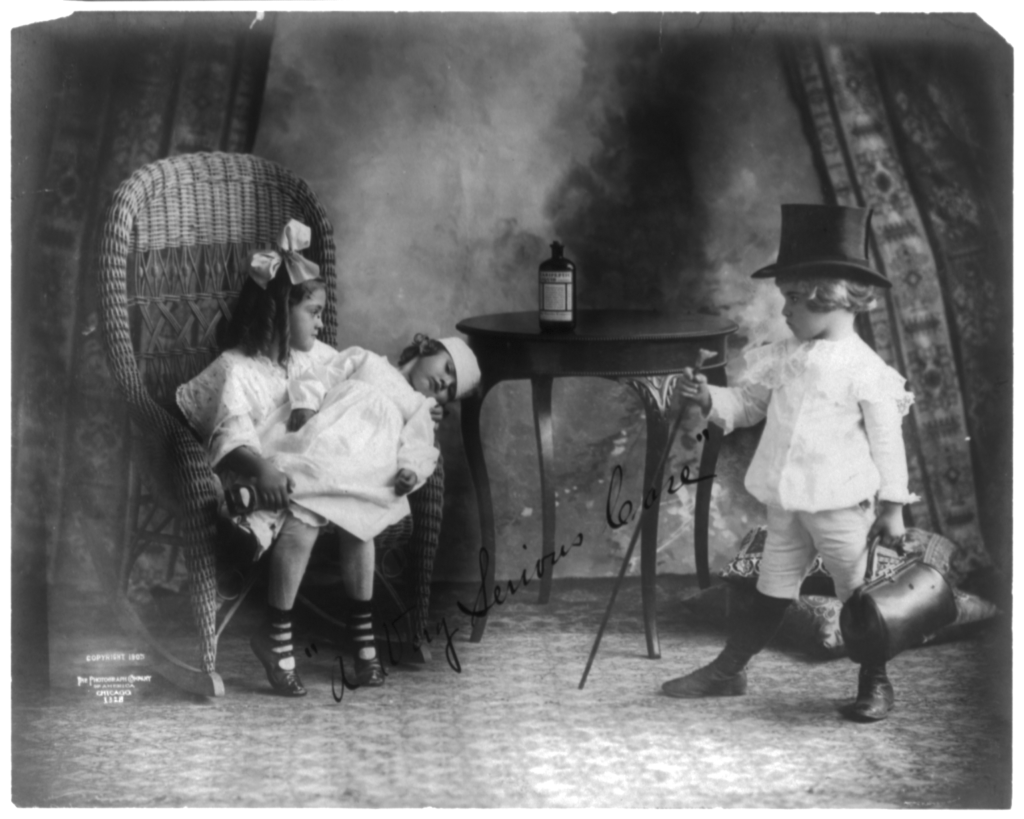
     [Image: "A Very Difficult Case," c. 1905]