
Reinhardt Commission Report: New Jersey Hospitals Need To Focus On Blocking and Tackling

    
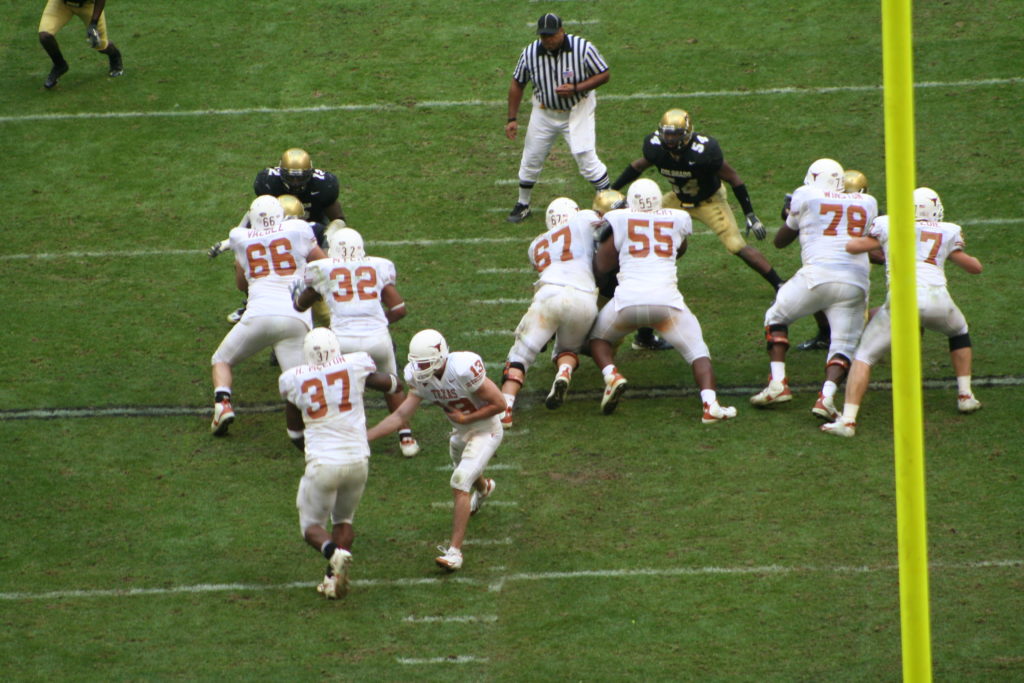
     [Image: 2005 Texas Longhorn football team playing the University of Colorado, by Johntex 2005]

          The New Jersey Commission On Rationalizing Health Care Resources (a/k/a the "Reinhardt Commission") issued its long awaited Final Report 2008 last week, and was immediately met with a strong response from the New Jersey Hospital Association. In a press release, and more thoroughly in an "Initial Response" distributed to its members, the NJHA praised the Commission's Report "for effort" but found "it falls short in addressing the most fundamental problem confronting our state's hospitals: inadequate reimbursement, especially from governmental payers. The Commission's recommendations provide some steps for stopgap or incremental relief, but New Jersey's healthcare crisis is beyond the point of incremental action."
           It is hard to argue with the NJHA's point that  the reimbursement to its member hospitals by governmental payers (Medicare, Medicaid and Charity Care) is woefully less than the cost of providing that care, and that this problem is at the root of the system-wide financial crisis in the state. Perhaps the Reinhardt Commission's Report could have said this more clearly, or more forcefully.
          But I did not read the rest of the Report to suggest only "some steps for stopgap or incremental relief".  Instead, I think the Report took a realistic approach to solving the big problems by recommending a variety of significant but generally feasible changes in the way hospitals do business. Yes, hospitals need, deserve and in some cases must have more governmental funding to continue their missions. But the idea that all of the hospitals' financial problems can and will be solved only by somebody in Trenton or Washington writing a big check distracts from what the Report says hospitals must and can do to help themselves.
          In short, and in the spirit of the big game this Sunday, the Reinhardt Commission Report essentially urges New Jersey hospitals to focus on their "blocking and tackling", those elements of the game that don't get the media attention or the big money endorsements, but tend to separate the winners from the losers. In particular, the Report contains a thorough and insightful analysis of the relationship of hospitals and physicians, with recommendations for improvement that could have a major, positive impact on the financial performance of most hospitals. I think that's something worth talking about, and I plan to do so in some posts to follow.
          In the meantime, Go Giants!

Who Wants To Sell Their Hospital On The Auction Block?

       
          [Image: Auctioneer and assistants, Cheviot, Ohio, 2004, by Rick Dikeman]
     

         Less than three months ago, I wrote here (with reference to Boston's Carney Hospital) about the need for financially distressed hospitals to involve all stakeholders in a collaborative process in order to achieve the best overall result.  Now I see that two New Jersey hospitals have long since passed that moment of opportunity and find themselves up for auction in bankruptcy proceedings.  Yesterday, The Record reported that auctions were set for Pascack Valley and Barnert Hospitals.  Today, reports indicate that Barnert's fate awaits the outcome of further creditors' wrangling in the Bankruptcy Court, while one of the bidders for Pascack Valley  is seeking to delay the auction of that facility scheduled for February 4.
          It is hard to imagine that any of the "stakeholders" involved in the early days of a financially distressed hospital scenario would purposefully choose to resolve their common problem by way of an auction sale in Bankruptcy Court.  Such proceedings are intended and designed to yield the best result for the hospital's creditors.  Although the interests of other constituencies (the hospital's Board, employees, medical staff, patients and community) may be brought into play, the creditors (and more precisely, certain creditors) are driving the bus.  This is not inappropriate given the underlying purpose of the Bankruptcy Code to fairly allocate the debtor's assets among its creditors.  But it makes no sense for these other constituencies to get on this bus if they have any choice in the matter.
          They often do have that choice, but fail to seize the opportunity.  It occurs well before the "B" word is first openly discussed, but when leadership of the hospital knows (or should know) that the status quo cannot be maintained.  Once that moment passes, the options available to the stakeholders begin to diminish, little by little, until one day there is no choice but to close the doors and hold an auction.
          The recently released Final Report 2008 of the New Jersey Commission on Rationalizing Health Care Resources (a/k/a the "Reinhardt Commission Report") addressed this problem to some extent by recommending (at Chapter 15, page 181) that state regulators create an "Early Warning System" to monitor and detect negative financial trends, and "to intervene at the level of hospital governance and management in a graduated fashion based on severity of financial problems and responsiveness of management."  Although a laudable effort, my guess is that this process will in many cases come too late, and when it does, will put state regulators in the driver's seat. 
          The hospital's stakeholders need to do better.  They can, but only through exercise of  leadership that acknowledges the realities of the hospital's predicament, and moves beyond pointing fingers and posturing into a collaborative process to find a solution.

In Praise Of The Low Tech Flip Chart

          
            [Image: Mediated Reality as illusory transparency, by Glogger, 10-09-2004]

            The use of high tech gadgets and digital technology in the practice of law becomes more prevalent every year.   An entire industry has grown up around creating the best presentation possible in the courtroom, within whatever bounds the court will allow.  This week, while preparing to mediate a case involving various related but off-setting claims among several parties, I sketched out on a legal pad a diagram of how those competing claims could be valued, discounted and traded off to reach a range of potential settlement.  It occurred to me that the parties might benefit from this approach (done, of course, with their permission and input at each step of the way), so I showed up at the mediation with my trusty flip chart and easel and put it to use.
            The result was terrific.  The parties and counsel were engaged and focused in a way that never would have happened if we simply talked about the claims.  It also permitted them to focus together on the process I was suggesting, rather than talking at each other.  The case settled -  not on the last terms I sketched out with their help, but on other terms that the parties were prepared to accept only because they had already established a mutual comfort level within the terms on the chart.
            I was very pleased but not too surprised.  In both advanced mediation courses I was fortunate to take at the Straus Institute at Pepperdine, the instructors made extensive use of flip charts to good effect, including demonstrations of how they can be used to engage parties and bring them actively into the process of formulating their own settlement.  It may not be "high tech", but it works. 

Garibaldi Inn of Court Revisits Hall Street v. Mattel

                       
             [Image: A view of Inner Temple Gardens, London, The Lud, 10-03-2006]

            Two months ago, I posted on the then pending oral argument in Hall Street Associates, L.L.C. v. Mattel, Inc.,  calling it "the most important ADR case of the year."  The case raises the question of whether parties can, by agreement, expand the scope of judicial review of an arbitration award beyond the grounds stated in the Federal Arbitration Act. Last week, I was able to attend the monthly meeting of the Justice Marie Garibaldi Inn of Court for Alternative Dispute Resolution, at which there was a wonderful presentation on the case and the oral argument before the Supreme Court.  The Garibaldi Inn of Court, named in honor of retired New Jersey Supreme Court Justice Marie Garibaldi, is one of the American Inns of Court, and may be the only one devoted to alternative dispute resolution. 
            The American Inns of Court are loosely modeled after the traditional English Inns of Court (Gray's Inn, Lincoln's Inn, Inner Temple and Middle Temple), and are "designed to improve the skills, professionalism and ethics of the bench and bar.  An American Inn of Court is an amalgam of judges, lawyers, and in some cases, law professors and law students. Each Inn meets approximately once a month both to 'break bread' and to hold programs and discussions on matters of ethics, skills and professionalism."
            At last week's program, New Jersey attorney and neutral John R. Holsinger provided an excellent procedural history of Hall Street and framed the issues now before the Supreme Court.  The Inn then heard from Eric P. Tuchmann, General Counsel of the American Arbitration Association, who submitted a brief on behalf of the AAA as amicus curiae, and who attended the oral argument.  It was fascinating to hear not only which Justices asked questions, but what each of them appeared to be thinking about how the resolution of Hall Street should be approached.  The consensus of opinion?  As other commentators have said, this one is tough to predict.  There is room for the Court to rule for either party, or to avoid the main issue entirely. 
           It was a rare evening.  In the company of active and retired New Jersey jurists of note and leading ADR practitioners, I was listening to a discussion of a Supreme Court case I had covered, being led by someone involved in that case.  It was everything that the Inns of Court are supposed to be, and I was grateful to be a part of it.  A special note of gratitude goes out to Robert E. Margulies, an officer of the Inn and New Jersey attorney and neutral, for inviting me into the Inn's membership last year.  Membership in an Inn of Court can restore one's faith in the professionalism that should be fundamental to the practice of law.  I highly recommend it.

Corzine Vetoes Expanded Wrongful Death Damages In New Jersey

                
           [Image: Veto image taken from a website by "The Office of the Clerk" of the U.S. House of Representatives, 10/29/07]         


           Yesterday, New Jersey Governor Jon S. Corzine "pocket vetoed" legislation addressed here previously that would have broadened the grounds for survivors' claims in wrongful death cases, including unlimited damages for "grief".  According to the New Jersey State Bar Association's Daily Briefing (members only), Corzine said that "unlimited damages based on emotional anguish or pain and suffering could have a significant impact on state and local budgets, since government entities are not infrequently named as defendants in wrongful-death suits, and there are similar concerns as the State undertakes efforts to attract and grow businesses here."
            Although the Governor did not specifically mention the concerns of healthcare providers in his veto message, this action caused a sigh of relief among healthcare industry advocates, who had worked hard to oppose the legislation.  No doubt the bill will be reintroduced. 
            Corzine recommended "that the Legislature consider alternative means of striking an appropriate balance, especially by granting more flexibility for courts to reduce excessive non-pecuniary damage awards and defining non-pecuniary damages less expansively" (emphasis mine).  Interesting possibilities.  But for now, at least, the dynamics of resolving healthcare wrongful death cases in New Jersey remain unchanged.

Happy New Year! NAF Notes Important Healthcare ADR Cases of 2007


             [Image: "Happy New Year To You", a 1908 postcard with artwork showing a frog holding a bottle of champagne with the cork popping.]


            Happy New Year!  I return to blogging after some time off for the holidays and to get my new business life in order.
            Thank you to Christina Doucet, Communications Specialist at the National Arbitration Forum, for bringing to my attention that four of the eighteen ADR cases identified as "most significant" by the Forum's 2007 ADR Law & Policy Year in Review are healthcare arbitration cases.  Significantly, all four of these decisions affirm the enforceability of arbitration agreements in cases of alleged medical malpractice or mistreatment of patients by a healthcare facility.  The cases are Reigelsperger v. Siller, 150 P.3d 764 (Cal. 2007), Covenant Health Rehab of Picayune, L.P. v. Brown, 949 So. 2d 732 (Miss. 2007), Hogan v. Country Villa Health Services, 55 Cal. Rptr. 3d 450 (Cal. Ct. App. 2007), and Owens v. National Health Corp., No. M2005-01272-SC-R11-CV, 2007 WL 3284669 (Tenn. Nov. 8, 2007).
            It will be interesting to see if cases decided in 2008 follow this pattern.  Even more interesting will be the success of certain legislative efforts (such as the "Arbitration Fairness Act of 2007") now being directed at protecting consumers from pre-dispute arbitration contracts - and which no doubt will be applied to patient/resident complaints such as those in the cases cited by the Forum.  Stay tuned.